

Liam Kalevi is one of Sweden’s biggest TikTok creators and Head of TikTok Marketing at influencer marketing agency Society Icon. The 23-year-old has at the time of writing 307k followers on TikTok and 15.3k Instagram followers, and in his videos, he switches between refreshing and comedic stereotypes of Swedish culture, giving different countries a persona and impersonating different types of people (the series ‘People who read horoscopes’ is a favourite of mine).
In an interview with Strong Contents, Liam shares his insights as a TikTok creator and a TikTok marketer and makes a strong case for why businesses should be on the platform (and why it’s so much more than an app where children do dances).
How did you get into TikTok in the first place?
It all started when I was moving from Stockholm to Barcelona in 2020. I was very excited to meet new people and explore a new city and a new culture, and obviously to get away from Swedish weather, and have some sunshine in my life. And that was very fun and enjoyable for about three weeks until the coronavirus hit and Spain went into complete lockdown. I was working at Google Ads at the time, and one of the first things to get cut were the advertising budgets, so I suddenly spent a lot of time alone in my apartment in Spain.
That’s when I downloaded this app, TikTok and posted my first video which was impersonating my parents, who are from Kenya and Finland, just for fun. But I quickly realized the power of the platform where with 0 followers I could reach 100 people, and after one month of posting one video a day I had 100,000 followers and over 10 million views. So I booked a flight back to Sweden and together with the founders of Society Icon, who I knew from before, we decided to set up our first TikTok community within the Society Icon app. Within one week of presenting this to clients we had our first campaign with the clothing brand NA-KD.
How is TikTok different to other social media platforms?
Authenticity is the most important thing on TikTok. Instagram, and social media in general, has evolved to showing this polished version of yourself, and I suppose that has become a bit stale. And so when TikTok came it really felt like a breath of fresh air, because TikTok is more about providing value, whether that’s through education or comedy, rather than looking good.
How difficult or easy is it to convince brands and businesses to be on TikTok?
It’s definitely easier now compared to last year. TikTok as a medium is much more established, especially in the Nordics. There’s a TikTok for Business office in Stockholm and the app has been around for a while. Now the conversations are less about whether or not to be on TikTok, and more about how to best use it.
Many business owners shake their heads at TikTok, convinced that it’s not where their target audience hangs out. What would you say to these sceptics?
It’s a shame, because it’s just not true. And the sad truth is that they are going to lose out in the end. The algorithm will serve you content based on what you like. I for example get a lot of comedy and educational content and my dad who is an avid language learner gets a lot of content in Spanish. I would say take the time to learn about the platform, just take one week, to get to know it better.
How important is it to stay on top of trending sounds, dances and challenges to succeed on TikTok?
I don’t think I’ve ever done a single trend, ever. It comes down to providing value and focussing on what you’re good at. My reasoning in the beginning was, ‘if I do the trends, then what? How does that make me different? It may get me a viral hit, but why would people want to follow me long term?’ So I just did my own thing.
What tips do you have for businesses, in particular smaller businesses, when it comes to TikTok?
The first thing that comes to mind is that if you are on Instagram, then you should definitely also be on TikTok. A lot of people say they don’t know what to post, but I say ‘just post something, anything’. Because once you publish your first TikTok you learn and then you just keep going. You don’t have to worry about a launch strategy, because that won’t matter in the long run. Do a bit of trial and error and find out what works for you.
Another thing to bear in mind is to provide value to your target audience in your particular industry. If you’re in fashion for example, you can show how you use your different outfits for different occasions. Or if you are in the food business, you can show some recipes. Brands, and humans in general, have a lot of things that they would like to say and communicate, rather than flipping it the other way and asking ‘What do people actually want to hear or see?’
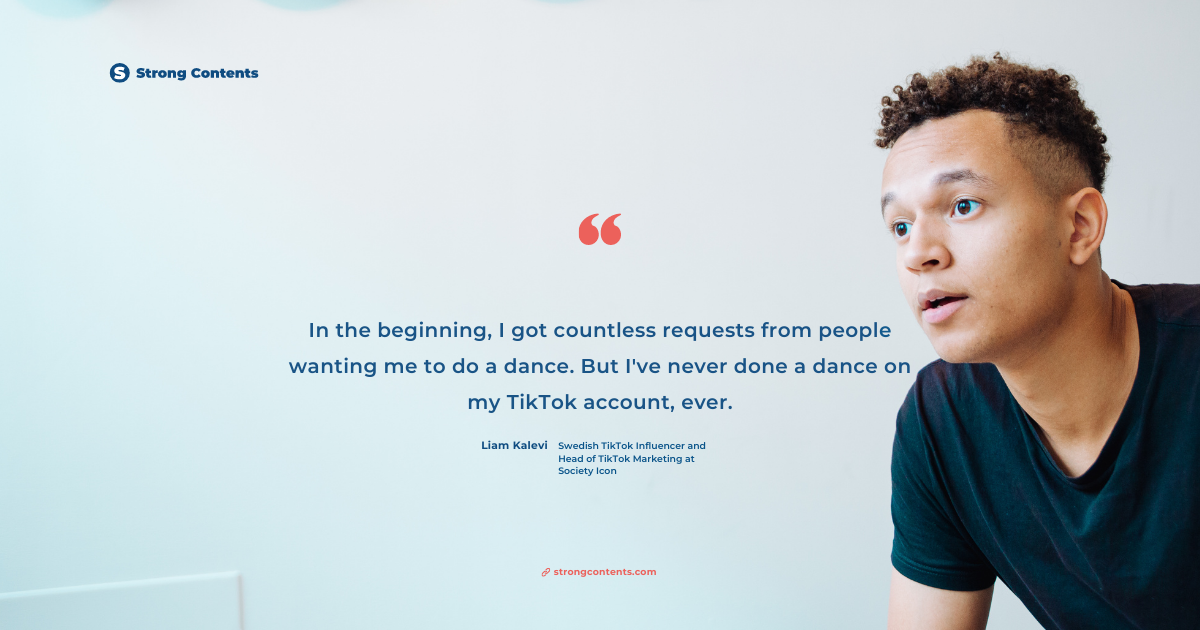
It’s also good to think about collaborations with established TikTok creators. I know it can be a bit daunting at first, but you should value the opinion of the creators themselves, because they have the data to prove that they know what they are doing. So cater the content to their style and don’t try to force something upon them. For example, in the beginning I got countless requests of people wanting me to do a dance. But I’ve never done a dance on my account, ever. I’ve refused all of those requests.
Do brands need to advertise on TikTok or should they focus more on organic reach?
That depends on your goals and budget. If you’re a large corporation with money to spend and you want to drive conversions, then go for advertising. What I would say though is that the organic reach is still so good. You still have the chance to organically reach out to countless new people. It used to be like that on Instagram and YouTube, but it doesn’t last forever.
How do you think your generation, Generation Z, will respond to brands and older people coming to TikTok? Will they move on to something else, is this a fast burning flame?
It’s like the circle of life. A new app comes out, it’s fun, it’s young. And then the older generations come, advertisers come, and it’s mainly the advertisers I would say, marketers ruin everything, and that’s just the way it is. You know, even though we are in the industry, we ruin everything.
But I guess from my perspective, partly as a creator, partly as a marketer, I just focus on what works in the moment. And what I know right now is that TikTok is still fun and hasn’t been overrun by ads yet. There is still this exciting feeling. Right now, this is the best platform to be on, by far.
Image credit: Liam Kalevi, Society Icon

