

Since the launch of Clubhouse in March 2020, the social media app has expanded all over the world. When the app first launched it was built on an idea that no other social media platform had tried before – live podcast-like discussions where people communicate in audio rooms. The release of Clubhouse also came at a time when the world had just been turned upside down and was in need of some real human interaction. Despite the explosion of what seemed to be the next big thing in social media, in combination with the demand for human communication, the trend started to fall. In this blog post you’ll be able to read about and discover factors that could answer what a lot of us might be wondering: What happened to Clubhouse?
Clubhouse launched in the beginning of the pandemic
In 2020, the coronavirus started to spread and suddenly the pandemic was upon us. Many countries went into lockdown and suddenly people couldn’t go on with their regular life. Some could work from home and had their families to keep them company, while others all of a sudden didn’t have a job or someone to spend time with. When Clubhouse was launched in the beginning of the pandemic, it seemed like almost a gift to society where individuals could actually talk to each other in live audio rooms, and connect with friends and strangers that shared the same interests.
Clubhouse’s growing pains
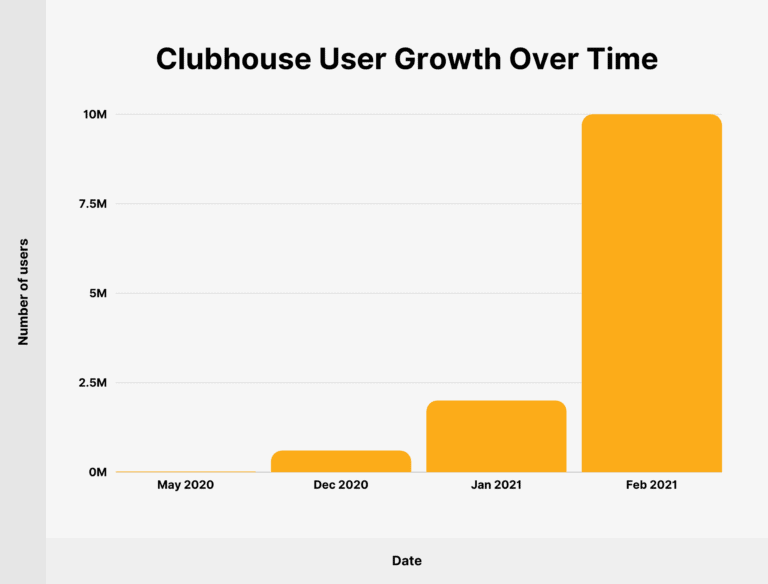
In december 2020, nine months after the launch, Clubhouse’s user base grew 10-fold and the first half of 2021 looked promising for the app. In the middle of 2021, Clubhouse was valued at $4 billion, but the worth of the app is unclear today. As much as it seemed like a very promising and new way of connecting online especially during the pandemic, Clubhouse might have bit off more than they could ultimately chew – maybe simply by remaining in its status quo while it was trending the most. Forbes journalist John Brandon describes Clubhouse’s fall as a “victim of its own growth”, in other words, Clubhouse grew too fast for its own good.
In November 2021, CEO of Clubhouse Paul Davison opened up in an interview with CNBC about the company’s growing pains since its launch. The hype around the app has calmed down notably – probably because the pandemic is coming to its end, mixed with the company’s growth spurt they maybe weren’t prepared for. Clubhouse struggled early when they tried to deal with a demand that grew much faster than expected. In the beginning of 2021, less than ten people worked at Clubhouse – today they’ve expanded to more than ninety people working with the app daily.
The falling Clubhouse trend
At the start of the summer in 2021, the social media app had 300 000 successfully created rooms each day – a number that went up to 700 000 later in the fall of 2021. This happened despite numbers of active users in the UK dropping from 550 000 each day in the beginning of 2021 to 160 000 active users in September 2021, according to data from App Annie. In an article from Apptica, one of the reasons for the falling trend is described as Clubhouse’s lack of broader functions, compared to other social media apps. At times, Clubhouse also struggled with criticism about how they handled hate, racism and for example antisemitism. This may have led to people leaving the social media app. Reading awful tweets from Twitter trolls is one thing – having them yelled at you in live audio-rooms is on a whole other level.
From exclusive to ‘eh’
In the beginning, Clubhouse was meant to be an invite-only app, but in July 2021 the company decided to ditch the invite-only rule and opened up the app for everyone with a smartphone. If they got rid of the invitation feature too late or if they should have never gotten rid of it in the first place is unclear. But a lot of their users lost their interest, especially iOS users, during that time. Last but not least, the Android-free period that existed for over a year might also be a factor of their popularity demise, as the Android version was released quite late – even though the app had more than 10 million Android installations after the launch, according to an article in Bloomberg.
Even if they initially had a huge number of downloads, the Clubhouse trend is easy to follow when looking at app rankings in Google Play and Apple Store. Earlier in 2021, the app ranked around top 10 in both systems. Today the Clubhouse app ranking in the United States is quite low. In Google Play the app is ranked as 25 under the category “social” and in Apple Stores’ category “social networking” it’s not even in the top 50.
Clubhouse in post-pandemic times
The Clubhouse trend peaked during the pandemic and the fall in the ranking list on the App Store might also have something to do with the fact that the pandemic is coming to an end in combination with their growing pains. During 2020 and 2021 the coronavirus pressed the pause button on everyone’s social life,, we were stuck in our homes and encouraged to stay there. Our world is now opening again and people can go to work and meet their friends in real life instead of trying to find other ways to communicate with people.
Or maybe audio-tech in itself is still experiencing growing pains, released into a world which is still hooked on videos and where the majority of people want to consume, watch and listen – not actively participate live or contribute with their own thoughts and knowledge. There’s also a whole generation of social media users that have an almost instinctive fear of telephones and “live audio”, having grown up with a keyboard as your main tool of communication.
But despite all of that, the post-pandemic period might not be the end of Clubhouse, at least not if we look at their statistics. Even though the ranking is quite low, the app was valued at $4 billion in 2021, which is a lot more than its valuation in may 2020, when it was worth $100 million. With more people working at Clubhouse they should even be able to handle any upcoming demands from their users.
It remains to be seen what will happen to Clubhouse in 2022, and if they will be able to regain their earlier lost users and gain new ones.
