

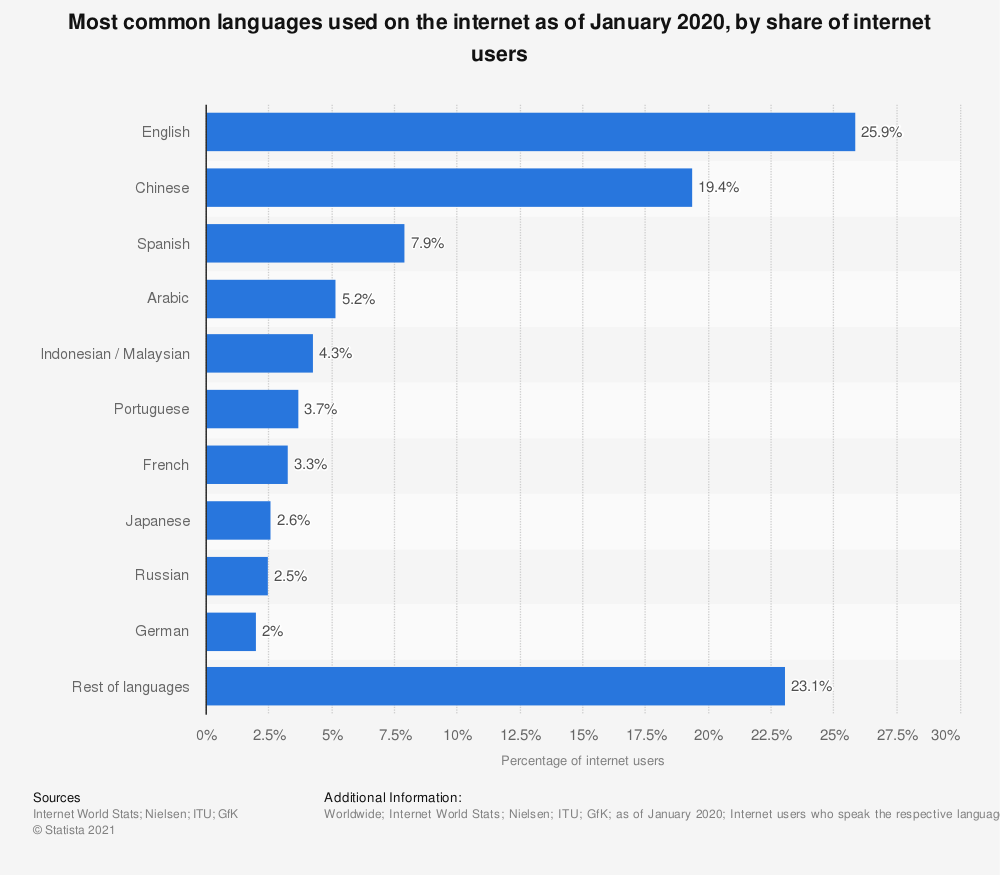
Communicating in English is an easy solution for companies that operate in multiple non-English speaking countries. But only having a website in English and producing English content could mean you are missing out on a ton of organic reach in the native language of your target audience. In 2019, searches done in the local languages stood for 20% of all the roughly 3.5 billion Google searches per day, according to Google. Depending on your industry and topic, you risk a very high competition of your English keywords and unless you have a lot of money to spend, it might be difficult for starting companies to compete with big, established companies for a good ranking on Google. So, if you have the capacity, why not invest in localized content by setting up a multilingual website and SEO strategy? These are our four tips to get started.
1. Know your target audiences
Researching your audience and knowing which words and phrases they use in their searches is a key component of a successful SEO strategy, no matter what language they speak. In English you can often rely on the American spelling and words while setting up your strategy, but in other languages you might be confronted with a greater variety of terms depending on the country or region your potential audience is from.
For example, in Spain the most commonly used word for pen is boligrafo, but in Central American countries, like Mexico and Panama, they use the word pluma. And in Argentina, Uruguay and Paraguay a pen is a birome.
It is therefore very helpful to create a profile of your ideal customer or customers and link specific keywords, in the correct regional tongue and even slang, to these buyer personas. You can then use Google’s Keyword planner or install a free keyword search tool, like Keywords Everywhere, to analyze your list and get a better insight into related and long-tail keywords. As far as free tools go, Google Keyword planner lets you quickly set the language and country when doing keyword research. You can even check the search volume of for example an English keyword in Sweden, if you need to target your English content to Swedish businesses only for example.
It’s a good idea to hire SEO experts and native-speaking copywriters who can help you brainstorm and check keywords. Direct translations won’t always work, and it pays off to spend some time checking the search volume and competition of as many keywords and related keywords and phrases you can think of. Better to end up with a long list and be able to narrow it down, than to miss out on areas where your website can really climb the rankings!
2. Get your URLs and technical SEO foundation organized
When you localize a website, your developer or webmaster will have to decide how to best structure the content. There are three different approaches, each with their pros and cons.
- Each language could get its own registered country code top level domain (ccTLD) where for example your Swedish version ends with .se instead of the generic .com. The main advantage of this approach is that it will be very clear to your audience and search engines what country you are targeting, which is especially helpful for e-commerce sites. The disadvantage of this approach is that it is expensive, as you have to register and pay for each domain separately, and you run the risk of your domain already being taken
- You set up subdomains. Subdomains are part of your larger domain name so you only need to register and maintain one domain. For a Swedish website for example, it would be ‘se.’ or ‘sv.’, followed by the domain name (it can still end with whatever TLD you chose, so .com for example). The main advantage here is that it is relatively easy to set up and you aren’t limited to how many languages you can host. The disadvantage is that Google will ignore any SEO practices you have implemented on your main site, which is why it’s so important you don’t only change the content on the page itself but also translate the URLs, title tags and meta descriptions.
- The preferred alternative: setting up subfolders. If possible, you should set up all your different localized websites as subfolders of your main domain. For a Swedish version of your website, this would be example.com/sv-se. Not only do your separate subfolders benefit from the ranking of your primary language, you still only need to register and pay for one domain.
All of the above points are extremely important for search engines to understand what your page is about and which demographic you are targeting. Making sure your multilingual websites contain the correct keywords will not only approve your ranking, but also your click-through-rate.
To learn more about how to write optimal URLs, title tags and meta descriptions, download our free SEO 101 Guide here.
Besides making sure that each of your localized websites has a strong technical foundation, it is also recommended to create a detailed sitemap with the language content contained in the data. Adding language properties will help search engines mark your pages correctly and display them to the appropriate users. You can create a sitemap with free tools like Yoast SEO or Google XML Sitemaps.
3. Add hreflang tags
While adding different languages to your website, you might run into a problem: duplicate content. Search engines generally aren’t too fond of websites that have multiple pages with exactly the same content and, even though the languages differ, it can still get flagged for having similar images, structure and links. You should never automatically translate your content, as Google might view it as spam, so it’s best to invest in some proper translation help.
To avoid getting downgraded by Google you should then add a hreflang tag. A hreflang tag is similar to the canonical URL, but specifically indicates to Google that your page is an alternate version of another page in a different language. Simply add this tag to the header section of your website. For example, Strong Contents is based in Sweden, so for the Swedish version of this blog it would look like this:
<link rel=”alternate” hreflang=”sv-SE” href=”https://www.strongcontents.com/post/4-tips-to-improve-the-SEO-of-your-multilingual-website”/>
Make sure all the equivalent content is linked to each other. If this is not the case, Google might not consider the markup valid.

4. Don’t forget to update your title and images tags
Since title tags are the first description of your page users will read while googling, it is important that this tag contains the keywords, in the correct language, they are searching for. Adding title tags does not only improve your ranking on search engines, it can also significantly improve the click‑through‑rate to your website. So, forgetting to update this tag could create confusion about your content.
Besides the title tag, you should also update the image tags on your non-English pages. This way not only search engines better understand what your page is about, it also supports visually impaired users that rely on descriptive ALT tags to navigate on your site. To make your ALT tags as user friendly as possible, avoid stuffing them with keywords. It not only results in bad user experience but can also be viewed as spam.


