

Did you know that the first five organic results Google displays get 67 percent of the clicks? Ranking high enough to make it to the first page of a search engine’s results, is one of the best ways to increase traffic to your website. But what strategy will help you get up there? SEO, SEA or maybe both? We’ll share our insights on how you can optimize your visibility in search engines.
What is SEO?
Search engine optimization (SEO) means adjusting your website in such a way, by using specific keywords and by improving the user experience, that you organically rank higher on the search engine result pages (SERPs) of Google or other search engines like Bing and DuckDuckGo.
For example, when someone searches for “hotel Paris” on Google, they are probably looking for a hotel room in Paris, France. If you have written a travel blog with great tips for a weekend in Paris or have recently opened your own B&B in the city, you want people to find your website. But for them to do so, you need to show Google that your site can provide the searcher with the best answer to their query.
Many people think of SEO as using as many frequently searched keywords as possible in the content of the page, but it actually requires the optimization of many more aspects of your website.
Google not only ranks websites on their content, but also on its mobile-friendliness, how quickly it loads and if it is generally accessible to users. You can read more about Google’s algorithm in our blog on its latest update or download our free SEO guide that will help you to optimize your website in ten simple steps.
What is SEA?
While SEO focuses on organic improvement in your search engine ranking, SEA is a paid method to help you reach the number 1 spot fast. SEA stands for search engine advertising, which means you will pay Google, Bing or DuckDuckGo to appear at the top of the SERP when someone is looking for specific keywords linked to your product or service.
Even though a search engine ad will place your website at the top of the search results, it is not going to give you the same click-through-rate (CTR) as an organic first spot. Search engine users overwhelmingly click on organic results over ads, by a margin of 94 percent to six percent.
This may sound like an investment in SEA is not worth it, but it actually is. Growing organically with an SEO strategy takes a lot of time, while SEA gives you an immediate shortcut to the top of the SERP.
Getting clicked on by six percent of all users is still a lot more than getting found by no one, because your website has landed on page five of the search results. Therefore, we would like to advise you to use a mix of both SEO and SEA, also known as SEM.
SEM – the best of both worlds
Because you are not the only business trying to reach the top of the search result page, relying solely on a SEO strategy is not going to be enough. Especially if you are trying to conquer that number 1 rank with popular English keywords.
Because other businesses are already paying to ensure their products appear at the top of the SERPs, and above yours, it is critical that you invest in a SEM strategy.
For SEM to work you need to combine paid search ads with a solid SEO strategy. Without a SEO strategy, you don’t have insights into which keywords you need to use in your ads to be sure that they will pop up at queries by your target audience.
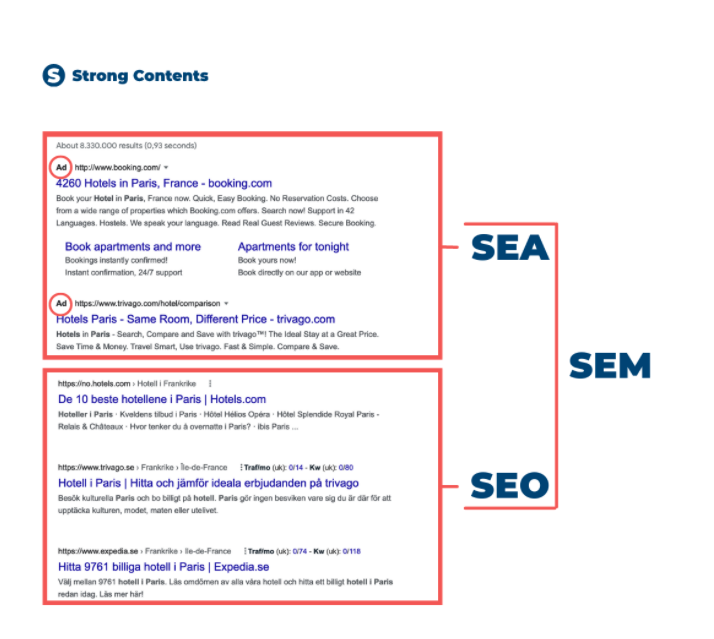
Setting up your search engine ads can be a bit intimidating, because you’ll need to enter into an ad auction. There you bid against other websites to be displayed at searches of certain keywords. Your bid equals the amount of money you are willing to pay per click (PPC) on your link.
To win this ad auction, search engines do not automatically pick the highest bid, they also do a quality scan of the ad and the landing page. The more relevant your ad and the content on your landing page, the more likely the search engine is to pick your bid as the winning one.
Therefore, your website needs to be ‘search engine optimized’ for you to be able to win the bidding for an ad.
With SEM you can set up a strategy that will serve your business in the short term (SEA) and the long term (SEO), and will grow your traffic, increase your conversions, and give you a high ROI.
Not sure where to get started? Strong Contents can help you set up a solid SEM strategy with keyword and website content optimization, so your future customers can find you. Contact us here and get your first hour of strategy consultation for free.
Sources:
- https://www.searchenginejournal.com/seo-101/seo-statistics/
- https://www.forbes.com/sites/forbesagencycouncil/2017/10/30/the-value-of-search-results-rankings/?sh=660cfae644d3
- https://www.smartinsights.com/search-engine-optimisation-seo/seo-analytics/comparison-of-google-clickthrough-rates-by-position/
- https://neilpatel.com/what-is-seo/
- https://neilpatel.com/blog/search-vs-social/
- https://neilpatel.com/blog/8-techniques-thatll-double-your-google-adwords-conversion-rate/
- https://www.searchenginewatch.com/2012/08/23/organic-vs-paid-search-results-organic-wins-94-of-time/
- https://blog.hubspot.com/insiders/seo-sem-faqs
- https://blog.hubspot.com/marketing/search-engine-marketing
- https://www.optimizely.com/optimization-glossary/search-engine-marketing/


